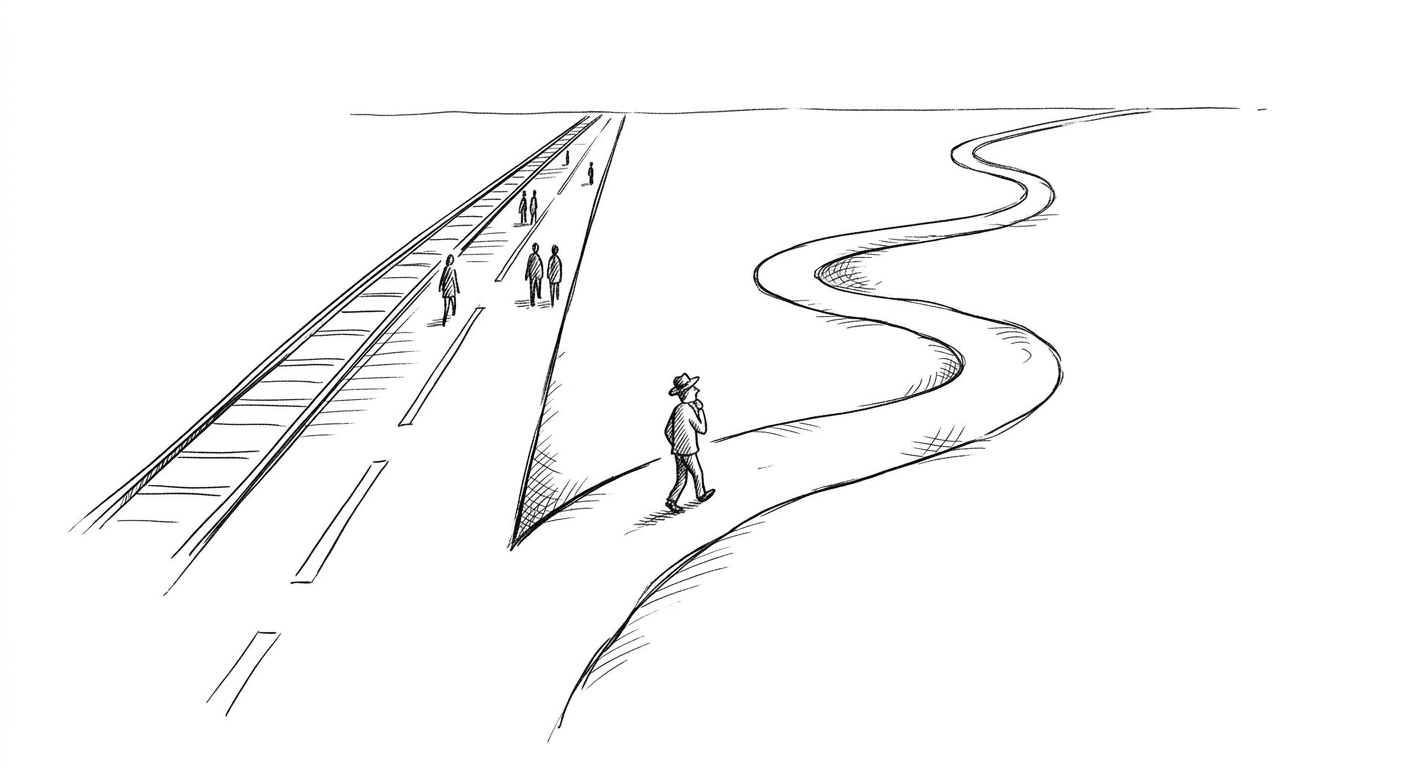
Last year, I confirmed what I'd assumed for much of my adult life: I have ADHD.
Labels can be problematic, I think. They can create excuses, blame, and otherness. In my experience, we're far more alike than we tend to assume, whatever labels we carry.
Plus, when it comes to psychological diagnoses, the line is often man-made – drawn in the sand somewhere, because it had to be, creating a binary distinction around something much less precise.
If I said, "all the tall guys on this side of the room and all the short guys on this side," how do you know where everyone goes? Sometimes it's clear (I know I'd go on the short side!) but where is the line? If we call it 5'9", then someone 5'8.9" is short and someone 5'9.1" is tall. Yet those two are far more similar to each other than they are to someone 5'1" or 6'10".
Still, people sometimes get a lot of value out of a diagnosis. One thing I got out of it was confirmation of something I'd already been doing – deliberately working with my strengths and around my weaknesses. And, with a label, I experienced more self-forgiveness for all the times I failed when I set out to be someone I'm not.
This is the problem with a lot of otherwise helpful advice. The advice-givers share what has worked for them as if it's what will work for others. "Do it this way. That's how you succeed."
No, that's how you succeeded.
And yes, it might work for me. Maybe it'll definitely work for me... if I could do it. But maybe my best option is another path.
The Holy Grail
I can't tell you how many times I've revamped my entire routine. I've tried a lot of different methods, all in search of the holy grail of optimal productivity. See, sometimes I can lock in and work extremely hard, extremely quickly. I can get a ridiculous amount done, whether it's something I produce or the amount I learn from studying.
For a while, I kept thinking, "Once I figure out how to do that for ten hours a day, I'll be unstoppable."
But I can't do it for ten hours a day.
Well, I can do it for ten hours one day – if the timing is right, my mood, my curiosity, and the task all align perfectly. If there's a juicy carrot dangling at the end of the ten hours.
But I can't do it for ten hours every day, or even half of the days.
So, I have to figure out how to get the most out of myself. More importantly, I need to be able to accurately forecast the future.
I've started several projects that have failed for the exact same reason:
When I began, I planned around me spending, say, fifteen hours a week on this project indefinitely. I was excited about it. I loved working on it. I knew I would continue to love it.
And, every time, I knew wrong. Four months later, I didn't want to spend much time on it. I was bored by it and excited about something else.
So, I've learned to plan appropriately. I only start things that can survive and succeed without my continued enthusiasm. And I pay more attention to things that I actually know I can keep showing up for and enjoying – a 90-minute live coaching call instead of ten hours of homework, for example. I pay attention to the things that consistently give me energy and the things that drain it.
And while I'm still seeking a likely-unrealistic version of my most productive self, I'm planning a lot more realistically.
Different
I've gotten to know a lot of poker players. As a group, I'm confident we're far more neurodivergent than the general population.
In fact, if I look only at the great poker players, I suspect every one of them would land beyond the man-made line in the sand – the one between "normal" and "different."
Which, of course, makes perfect sense. To be exceptional is, by definition, to be an exception.
I recently launched what I guess is a podcast. I say "I guess" because like me, the podcast format isn't typical. I'm doing one-off, 1:1 coaching sessions and recording the whole thing, while trying to pretend the camera isn't there.
Despite doing a lot of group coaching and some 1:1 coaching, one-off sessions are an entirely new coaching format for me. So, I'm learning as I go, and I'm scared about putting it out there for public consumption, as I explain in the intro to episode #1.
I've committed to doing ten of them and seeing how it feels and how much people enjoy it.
It's not a podcast about neurodivergence, but my guests are Beyond The Game members, who are largely successful poker players. So, I'm sure common themes will emerge.
In my first episode, I talked to Fabian, a BTG member since the beginning, a great poker player, and a fellow ADHDer. The topic came up on our call, which is what made me think to write this in the first place.
If you like my writing, I think you'll enjoy it: