I have worked with a lot of people you'd call high-performers – ambitious people always looking to grow and improve.
And for as much as they already know, and as obvious a topic as this is, you'd be very surprised how often the phone comes up.
We get into talking about their schedule, their goals, their output, and eventually, I learn about their routines. Of course, using the phone is part of their routine. And so far, it's always more of a detriment to their work and lives than it needs to be – and each time, the person says some version of the same thing: "Yeah, I know. I know it's bad."
They know. You know. I know. We all know.
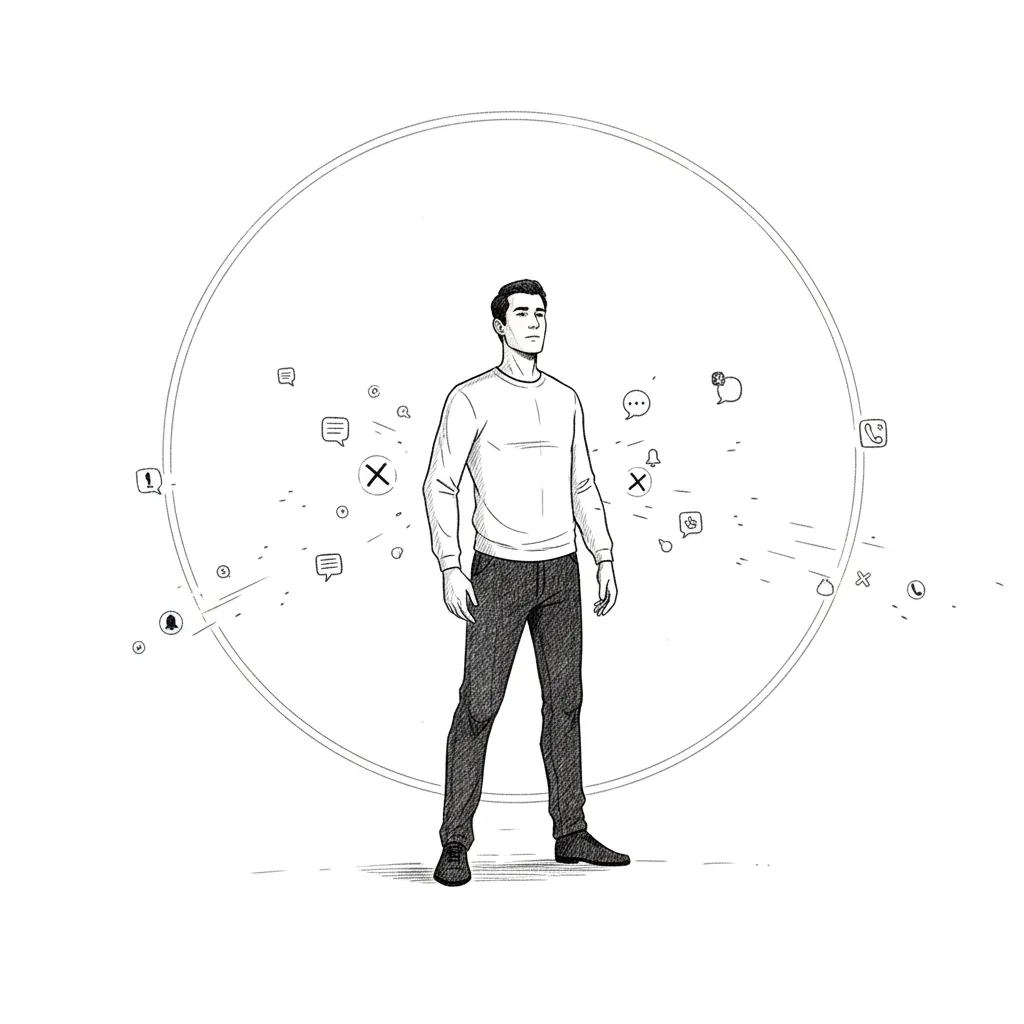
Control Your Airspace
And yet, every time I revisit this topic – even in a room full of people who take their performance seriously – some people get a ton of value from it. I've had to talk myself into bringing it up – including in an email like this – because I feel like people don't want to hear things they already know.
But knowing and thinking about are different things. And thinking about something and doing something about it are even further apart.
So that's what this is – a reminder. Of a thing you already know.
That Doesn't Add Up
The natural tendency is to think about your phone in terms of time. You've got your hours – playing, studying, working, whatever – and checking a message takes 20 seconds, and scrolling for five minutes takes five minutes. And at the end of the day, you think: Okay, I spent maybe an hour total on social media. That's not so bad. I still had plenty of time for everything else.
Some people argue that social media is educational. And in theory, it is. There's tons of very valuable content out there. But if you're not using it carefully (really carefully), you're getting a small dose of positive mixed with a large dose of negative.
And much of the negative part, you don't even notice.
I'm not a neuroscientist, so I won’t be quoting studies or speaking in certainties. But there are two concepts I keep coming back to because they match what I've experienced and what I've seen in many other people. The first is attention residue.
Attention Residue
Say you're working on something – studying a solver output, reviewing hands, writing – and you hit a wall. There's some friction. You're stuck on something, and it's not clicking. And in that moment, your phone is right there. Or Twitter is one tab away. So you take a quick look. Just 60 seconds – maybe 90. Then you come back to what you were doing.
That didn't cost you 90 seconds. It cost you more, and potentially much more, if you're like me.
The wall you hit right before you grabbed your phone can be the moment right before things start to click. Pushing past the friction is (part of) how you get into a flow state. When your brain is forced to sit with a hard problem, it can be uncomfortable, but it can have great returns.
But when you have an easy escape hatch every time you encounter resistance – Oh, I'll just check this real quick – you never push through. You bounce between things, you come back slightly less focused, and you never get into that deep, locked-in state where your best work actually happens. The hard stuff gets pushed off or done poorly, and you call yourself a good multitasker.
I'm sure you can remember poker sessions where you were really locked in – where reads came easy, decisions felt clear, and you really felt great. And you can remember sessions where everything felt foggy and slow and hard.
If I had the secret to harnessing flow state on demand, I could sell a course on it for $20,000. I don't have that secret, but I do know one of the things that actively kills flow: giving in to distractions when things get tough. Starting to study, then checking a text, then coming back, then seeing a notification, then coming back again.
Each interruption doesn't just cost you those seconds. Depending on the type of brain you have, it might cost you anywhere from 5 to 20-plus minutes of refocus time. And those 20-plus-minute recoveries tend to be more common in the ADHD and other unique minds that are often attracted to poker in the first place. I would know.
I've read about studies showing that simply having your phone near you – even if it doesn't buzz, even if no one texts – hurts your focus and productivity. Across the room is better. Out of the room entirely is better still.
And it's not just the phone. If you've got your email open, and Discord, and Slack, and Telegram – notifications popping up across your desktop – same thing. It may not feel like much, but it's death from a thousand pings.
The Dopamine Problem
The second concept is dopamine. A dozen paragraphs later, I'm still not a neuroscientist, but this one also lines up with everything I've seen and experienced.
Apps, and most phones, are designed to keep you on them. They're built by really smart people with really good data, and their entire job is to make you stay. The way they do it is by making the experience exciting – the novelty of opening your feed, the little rush when someone likes your post, the pull of wanting to reply so you can get a reply back. All of that triggers dopamine. Lots of it.
The problem isn't just that it makes you want to keep scrolling – although it does and that's unfortunate, too. The bigger problem is that dopamine also drives your motivation for everything else. It's part of what makes you want to study, want to stick to your habits, want to push through a tough session. When you're getting bucketfuls of it for free – just by picking up your phone – the smaller, harder-earned bits from focused work start to feel like nothing.
So you lose much more than focus. You lose motivation. The study session you planned feels like a slog before you even sit down. The work that used to feel engaging now feels boring.
The work didn't change, but your brain's baseline for stimulation went up.
What I Actually Do
So this is your reminder that these costs exist, they're real, and they go way beyond the minutes you can count.
A lot of BTG members have found real success with simple structural changes. Leaving their phone in another room while they play online. Keeping it in the car when they go to the casino – or at least in a pocket, turned off.
Willpower is finite. The point is making the distraction harder to reach so you don't have to fight it constantly.
For me, what's worked best is protecting my mornings. I put my phone on airplane mode before bed (and an automation does it if I forget to) – partly because it stops me from scrolling at night, which is its own very costly problem. Then I keep it on airplane mode. I have an automation that turns it off at 10am, which gives me about four hours of completely uninterrupted work before I even see a text.
I don't open anything on my computer that can receive a message (on my good days. I slip sometimes).
In my experience, the difference is dramatic. My mornings are wildly more productive when I'm not fighting my phone. I'm not checking. I'm not wondering who texted. I'm not deciding whether to look. I'm just working. And the experiences of people who I've talked to about doing the same tend to be similar directionally – sometimes not as potent as it is for me.
I Can't!
People very often push back on an idea this "radical." Nobody can reach me? No phone at all at bedtime? The most common things I hear are:
I can’t do it. I need to be reachable. What if there's an emergency?
Or
I like to listen to podcasts to go to sleep, so I can't do it. Oh well.
Do you really need to see that message right now? Is it actually true that you can't see it three hours later?
And if the answer genuinely is yes – if there's a spouse, a parent, a kid who might need to reach you in an emergency – there are solutions for that. Separate lines. Certain contacts that bypass Do Not Disturb.
And if you need to listen to podcasts – guess what? You can download podcasts! There are other devices that can play podcasts for you! It's 2026.
I haven't yet heard an excuse that isn't solvable.
Now, I have no idea if what works for me will work for you. Maybe your issue is something else entirely. But the point remains – distractions cost you a lot, and there are usually simple ways to make yourself noticeably more productive and happy.
You could finish reading this and then think about it for 5 minutes, create the solution in 10 minutes, and those 15 minutes could save you a hundred hours this year.
Or, you could think "that sounds like it would help. I'll do that one day," and continue bleeding time, energy, and focus.
Action is on you.