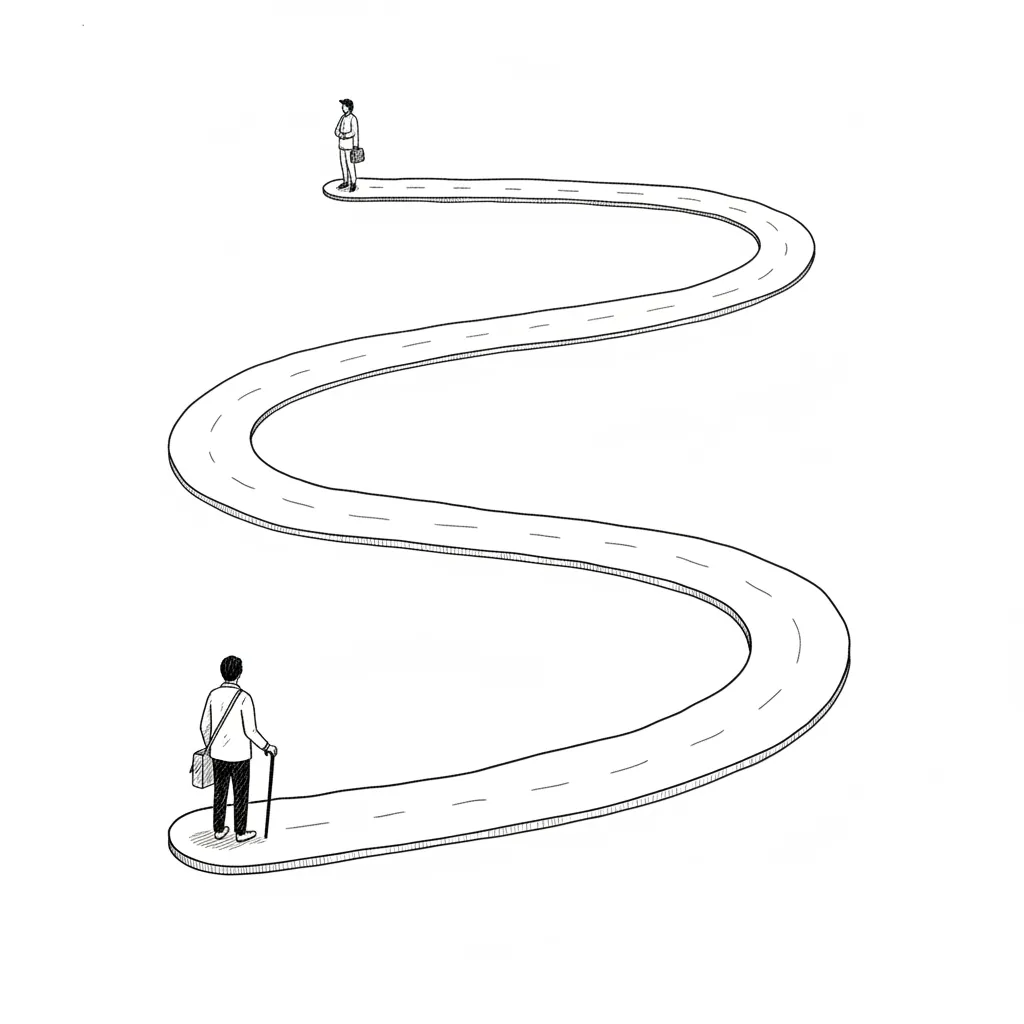
Today, I'll tell you something embarrassing and hope it's helpful.
When I launched BTG, I prepared the first month and a half of lessons beforehand, with a plan to get (and stay) even further ahead.
Three months later, I was consistently preparing my lectures the week of. Sometimes the day of.
This is a program where I'm teaching people about habits, discipline, structure, and accountability – and I'm pulling my slides together the night before.
It wasn't because I didn't care. This was something I'd just launched, something I was genuinely excited about, something I'd decided to make my primary focus. The members were counting on me. I wanted to deliver for them – really deliver, not just show up and wing it.
So every week, I'd tell myself: This week, I'm going to start early. I'm going to have my lesson ready days in advance. And every week, I wouldn't. I would start, but without fail, the day before, there was some serious finishing up and polishing to do.
I kept telling myself it was a discipline failure. I need to be better. I need to start earlier. But that didn't sit right. It didn't line up with my beliefs.
One of the things I actually teach – something that comes up a lot in BTG – is the idea that when you're not doing something you think you should be doing, there might be a meaning problem. That the reason you're not doing the thing isn't laziness or lack of discipline. It's that the thing doesn't mean enough to you yet.
But it didn't make sense. BTG meant a lot to me. Helping these people meant a lot to me. And, truthfully, what they thought of me – how happy they were with what I taught, or how unhappy – mattered a lot to me, too. So if meaning was my framework for understanding why people don't follow through... what was going on with me?
I'll come back to that. First, the part that I teach.
"I Should"
Say you've been meaning to get in better shape. You've tried before, plenty of times. And every time, the same thing happens – you go hard for a few days, maybe a few weeks, and then something comes up, and you stop. And then a couple months later, you try again.
If I asked you, "Why do you want to get in better shape?" you'd probably say something like: I know it's good for me. I want to look better and feel better. And those are true. But do they actually move you? Do they make you want to get out of bed early and go to the gym on a Wednesday in February when it's cold and dark outside?
For most people, "because I should" and "because it's good for me" is not enough fuel. Because it's not really meaning – it's an obligation. And obligations, at least for me, make terrible fuel.
Two Options
There are two paths I take when something doesn't have enough meaning to stick, and those are the two I'll suggest to you.
The first is: Don't force it. Accept that you don't care enough about this thing right now to actually do it consistently, and stop beating yourself up over it. Not everything needs to be on your plate right now.
I'm all for setting goals, but having things on your to-do list that never get checked off has a real cost beyond the wasted ink. Carrying all these “shoulds” on your shoulders is a great way to feel worse about yourself and lose motivation to do the things you really want to do.
The second option, if there's not enough meaning, is to try to find the meaning. Really dig for it.
The Exercise
There's an exercise I've seen in goal-setting contexts that works great for this. I've done different variations, but the core idea is simple: you take the thing you want to do, and you ask yourself what it would do for you. And then you take each answer and ask it again. And again. And you don't stop until you've built a list of at least twenty reasons – ideally more.
Most people stop at three or four. "I'd have more energy. I'd live longer. I'd feel more confident." Those are fine, but do you connect with them?
Do they actually move you, emotionally? If not, good luck getting them to move you physically.
The point of going deeper is to get past the surface and into the part where you actually feel something – where it stops being generic health advice and becomes yours. I’ll use fitness as the example, and I'm going to go deep so you can see what happens when you don't stop at three reasons.
Say you're a poker player who wants to get in better shape. You start the list.
Getting in better shape would mean...
I'd have more energy during the day.
I'd probably live longer.
I'd feel more confident in how I look.
Standard stuff. But now take "I'd probably live longer" and ask – what would that actually mean for my life?
I could watch my kids grow up – know them into their forties, fifties, sixties... maybe beyond.
I could be there for graduations, weddings. I could support them through all of these big milestones.
I could meet my grandkids. I could actually know them, be part of their lives, and see who they turn out to be.
With more years, I could take on projects and ambitions I've been unable to get to.
Go deeper. What would that do for me? And then, what would those things do for me?
I could have more of an impact on the people I care about.
All of my personal goals, my work goals, the things I want to contribute to – I'd have more runway for all of it.
And not just more time, but more energetic time. There's a real difference between being alive at 80 and being active at 80.
I could actually see the legacy I'm leaving behind.
I could mentor not just my kids but also my extended family, younger players, and people coming up behind me.
Now go back to "I'd have more energy during the day." What does that actually get you?
More physical energy for playing with my kids – getting on the floor, running around, not being the dad who sits on the bench at the park.
I'd be more productive. I'd study more.
I'd play at a higher level during my poker sessions. Less brain fog, fewer spots where I'm just going through the motions.
That means more money: better decisions, fewer mistakes, and a higher win rate.
It means actually reaching the financial goals I've set for myself, instead of always feeling like I'm chasing them.
Moving up in stakes. Beating bigger games.
Pride. Confidence at the table. Confidence in the community.
Now go back to "I'd feel more confident in how I look." What does that open up?
I'd enjoy being at the beach instead of thinking about my shirt.
I'd feel more attractive to my partner. I'd change the way I carry myself around the person I love.
That's good for the relationship. I’d feel good about myself and show up differently; we’d grow closer and happier
together.
Feeling comfortable in my own skin at poker events, dinners, wherever – instead of that background hum of self-consciousness.
Keep going.
With more pride and confidence, I'd speak up more. Share ideas I've been sitting on.
With a better relationship, we'd be better parents together. It compounds in so many ways.
I'd sleep better, and when you sleep better, everything else gets easier.
I'd be modeling something for my kids. Showing them how to live healthy. I might even be extending their lives simply by
the example I set.
Less anxiety about getting older. Less dread that the clock is running out and I'm not ready.
More willingness to say yes to things – trips, activities, opportunities – because I'd feel physically up for it, confident, proud to be out in the world.
With more productivity and more years, I could create things that outlast me. Write something. Build something.
Feeling good about myself would make me a happier person and a better friend and family member.
I'd have less guilt. Fewer unchecked “shoulds”.
I very easily could (and would suggest you) go on, but I don’t want to bore you any more than I already have!
See The Difference?
How did that feel?
Compare it to: I should get in shape because it's good for me and I'd have more energy.
One of those is an obligation that you'll probably write on a list and forget about. The other one connects getting in shape to your kids, your career, your relationship, and your legacy. Somewhere in that list, it went from a "should" to a "get to." It went from an obligation to a vision, an ambition, and, hopefully, excitement.
Making It Last
The tricky thing about meaning, even when you've found it, is making it last.
I've had to keep coming back to meaning – rereading, reminding myself. It's a little bit of a hassle, but it's entirely worth it.
I like to use the analogy of pushing a kid on a swing. One big push, and he'll swing for a while, but not forever. The friction of the chains and the wind resistance are the forces of life – distractions, emotions, other passions.
Eventually, you'll be too far removed from the push of your meaning. So give the kid another push every once in a while.
Don't just write the list and put it in a drawer. Put it somewhere you'll see it. Review it before the workout. Look at it once a week. Remind yourself what you're actually doing this for. If you don't, your meaning will usually get replaced by the “shoulds” that we were trying to conquer in the first place.
So What Was Going On With Me?
Now back to my BTG mystery.
If meaning is the thing that gets you to actually do hard things, what was happening with my lesson prep? Because it wasn't a meaning problem in the usual sense. I cared deeply about delivering something valuable. I cared about helping members make real changes in how they approached poker and their lives. I cared about not letting them down. And, selfishly, I cared about what they'd think of me. Would they be disappointed in a lesson? Would they think the content was weak? Would they start wondering if the program was worth what they paid?
All of that should've been more than enough to get me started weeks in advance.
But it wasn't. And it took me an embarrassingly long time to figure out why.
It dawned on me while I was preparing a lesson about – of all things – meaning. I wish I could say I figured it out through deep introspection, but no. I was literally making a slide about meaning and went, "Oh!"
The meaning was all there. But five weeks before the call, I wasn't choosing between "do something great" and "disappoint everyone," which would've been all the meaning I needed.
I was choosing between "do it now" and "do it later."
And because I'm a veteran procrastinator – because I've proven to myself, again and again, that I can wait until roughly the last minute, morph into “Super-Phil,” and pull together something really good (probably better than it would've been if I'd started months in advance) – "later" didn't cost me anything. There were no stakes – no meaning.
The meaning, if I wanted to find it, would lie more in the realm of "getting work done ahead of time so I could focus on other things" or "avoid the stress of rushing last minute."
But the truth is, I don't mind the rush. I thrive in it. And, as I said, I think it actually leads to better work.
So, for now, I’m content with waiting for the meaning to kick in. And in the meantime, there's no guilt, no shoulds, no extra unchecked boxes on my to-do list.
In this area, I'm still a procrastinator. The difference is that I'm choosing to be.
– Phil